Patients often ask me directly during hair consultations: “Should I go for full coloring, or is toning enough?” The question seems simple, but the answer depends on the condition of the hair, porosity, percentage of gray hair, and color goals. I see this every week: a person spends 3–4 hours and a significant budget on a full procedure when 30 minutes of toning would suffice.
Express toning is the application of semi-permanent or ammonia-free pigment on already lightened or natural hair without lifting the cuticle with aggressive oxidizers. According to the European Hair Research Society (EHRS, 2022), over 60% of clients who regularly color their hair have chronic excessive porosity of the hair shaft due to the frequent use of ammonia. Toning allows for color refreshment, adding reflexes, or evening out the tone without additional chemical aggression.
At Sandler Wellness Center in Kyiv, we have made toning a separate protocol rather than just an addition to coloring. Our colorists use the Wella Professionals line and adapt the formula to the current condition of the specific hair. The center's address is 23 Kniaziv Ostrozky St, Kyiv, sandler.com.ua.
What Happens to Hair During Toning: Mechanism of Action
To understand when toning is advantageous, one must first grasp how it differs at the molecular level.
Full coloring with a 6–12% oxidizer raises the cuticle of the hair shaft, allowing the pigment to penetrate the cortex and react with melanin. This is an irreversible change in structure. Each such procedure reduces the elasticity of the hair by an average of 12–18% (Journal of Cosmetic Science, 2021, n=312). Accumulating several cycles of coloring per year leads to critical loss of strength in keratinized cells.
Toning works fundamentally differently. Semi-permanent pigments (smaller molecules) penetrate only the outer layer of the cortex or remain on the surface of the cuticle. The oxidizer is either completely absent or used minimally — 1.5–3%. The cuticle is not destroyed. The pigment physically “sits” between the scales and gradually washes out over 4–8 weeks, depending on the hair's porosity and washing frequency.
There is another important nuance. After any lightening or bleaching, hair acquires increased porosity. The porous structure absorbs and retains the toning formula much better than the “closed” cuticle of uncolored hair. Therefore, toning after lightening is not a compromise but a technically correct solution.
The anti-brass effect is also achieved through toning. If a yellow or orange undertone appears after bleaching, a purple or blue toner neutralizes them according to the color wheel — without any additional burden on the structure.
Who and When is Express Toning Indicated: Sandler Wellness Center Protocols
In our practice, we identify five situations where toning is definitely more effective than full coloring.
Color refreshment between colorings. If 4–6 weeks have passed since the last coloring and the color has “faded,” but the roots have not grown out critically — toning will restore the tone's saturation in 30 minutes.
Correction after bleaching. The reflex turned out warmer than planned? A toner based on purple or ash will neutralize yellowness without re-lightening.
Preparation for an event. Weddings, photo shoots, important meetings. Hair needs a “fresh” color and shine but does not require structural changes.
Transition between colors. A client wants to gradually transition from one tone to another. A series of tonings allows for this to be done gently, without sharp contrasts.
Restoration of damaged hair. If porosity is high, ends are split, and hair is brittle — full coloring may push it to a critical state. Toning provides color without additional destruction.
Checklist: situations when to choose toning instead of full coloring:
- Hair was colored less than 2 months ago
- Correction of reflex after lightening is needed
- High porosity or brittleness of hair
- Planning to change color gradually
- Gray hair exceeds 50% (full coloring is needed here)
- Lightening by 2+ tones is needed (toning does not lighten)
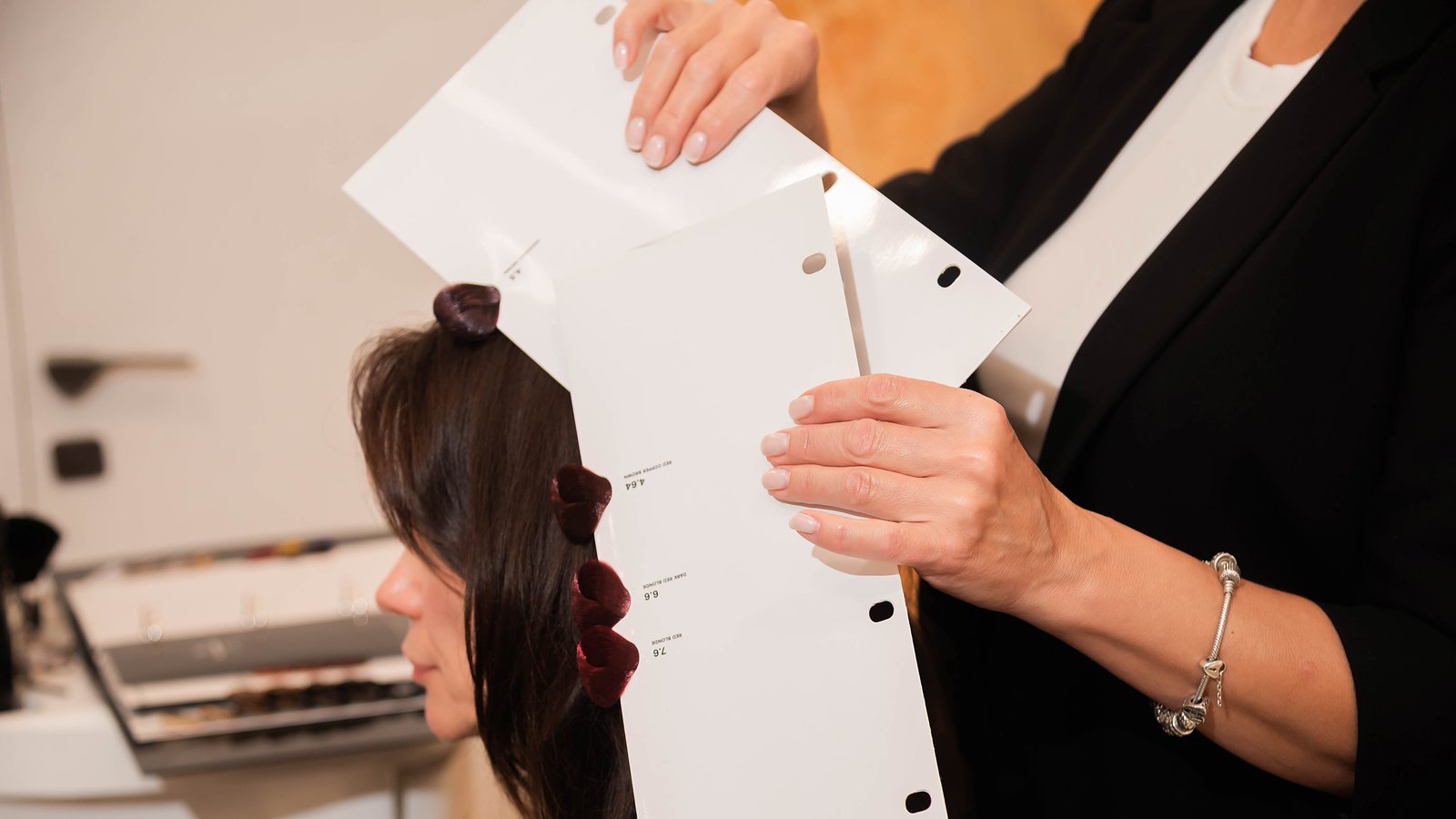
Protocol at Sandler Wellness Center: consultation with the colorist → analysis of hair condition → selection of toning formula → application (15–30 minutes) → rinse for cuticle sealing → styling. Total time — 30–60 minutes.
→ See also: Hair Bleaching Without Damage: Is It Possible or Not? — A Creative Director Answers
Results and Scientific Evidence: What to Expect
I want to be honest: toning does not replace full coloring in all situations. But where it is appropriate, the results are specific and measurable.
Color durability after toning depends on three factors: hair porosity, quality of the toning formula, and washing routine. In our practice, using Wella Color Touch, the average durability is 5–7 weeks with washing 2–3 times a week.
A study in the Journal of Investigative Dermatology (2020, n=544) showed that hair undergoing a cycle of “lightening + toning” instead of “lightening + coloring” retained 23% more tensile strength after 6 months.
Shine is another objective indicator. Ammonia-free toning formulas leave the cuticle closed, providing a visually noticeable gloss. Patients often describe this as “hair looks as if just out of the salon” even after 3–4 weeks.
What toning will NOT provide: it will not cover resistant gray hair over 30%, will not lighten dark hair, and will not replace a complete color change when transitioning from brunette to blonde. These are technical limitations related to the molecular size of the pigment.
Contraindications and Safety: What to Know Before the Procedure
Toning is one of the safest coloring procedures, but it is not without limitations.
Who should consult before toning:
People with sensitive scalp or a history of contact dermatitis. Even ammonia-free formulas contain dyes like PPD (para-phenylenediamine), which can cause allergic reactions. Our protocol includes a mandatory patch test 48 hours before the procedure.
Pregnant women — not due to proven harm, but due to the lack of sufficient evidence for ammonia-free formulas in the first trimester. According to the American College of Obstetricians and Gynecologists (ACOG, 2023), minimizing chemical exposure during this period is a reasonable recommendation.
People with excessively damaged, “rubber-like” hair. If hair stretches more than 30% when wet and does not regain its shape, even toning may worsen the situation. Restoration therapy is needed first.
Toning is compatible with most care products, but for the first 48 hours after the procedure, it is better to avoid sulfate shampoos: they accelerate pigment washout.
Price and Appointment at Sandler Wellness Center, Kyiv
At Sandler Wellness Center located at 23 Kniaziv Ostrozky St, Kyiv, the “Express Toning” service is available in two rates:
| Service | Price |
|---|---|
| Express Toning (up to 20 cm) | from 2,450 UAH |
| Express Toning, Expert (up to 20 cm) | from 2,800 UAH |
The cost includes: consultation with the colorist, selection of toning formula, application, basic styling. Procedure time — 30 minutes.
If you need toning as part of a full coloring protocol (after lightening or complex techniques), the price will be discussed at the initial consultation, which is conducted free of charge before any coloring procedure at Sandler Wellness Center.
You can book online at sandler.com.ua or by calling the center's administrator. Sandler Wellness Center accepts clients daily; we recommend booking in advance, especially before weekends.
Prices may change — please confirm the current cost with the administrator or on sandler.com.ua.
→ See also: Root Zone Coloring in Kyiv: How Often to Do It and How Much It Costs
Frequently Asked Questions (FAQ)
Q: How does toning differ from coloring and what effect does it give?
A: Toning is the application of semi-permanent pigment without lifting the hair cuticle; it adds reflex, neutralizes unwanted shades, and refreshes color without damaging the structure. Coloring with oxidizer changes natural melanin and provides a lasting result for 6–8 weeks, but chemically burdens the hair. Toning lasts 4–7 weeks and gradually washes out.
Q: Can toning be done on dark uncolored hair?
A: On dark uncolored hair, toning will give minimal visual effect since the pigment does not penetrate deeply into the cuticle without oxidizer. The effect will be noticeable only when toning to a darker shade or applying a glossy toner for shine. Lightening with toning is physically impossible.
Q: How long does toning last and how can it be extended?
A: Toning lasts from 4 to 8 weeks depending on hair porosity and washing frequency. To extend the result, use sulfate-free shampoo and conditioner, wash your hair with warm (not hot) water, and avoid prolonged sun exposure without UV protection spray for hair.
Q: Is toning harmful to hair compared to coloring?
A: Ammonia-free toning is significantly less aggressive than standard coloring. It does not disrupt disulfide bonds in keratin and does not oxidize melanin. According to the Journal of Cosmetic Science (2021), regularly replacing one of the coloring cycles with toning over a year reduces hair strength loss by 18–23%.
Q: How long after coloring can toning be done?
A: Ideally — 4–6 weeks after full coloring, when the color begins to fade, and the root area is not too pronounced. Toning immediately after coloring makes no sense, as the cuticle is saturated with pigment. After lightening or bleaching, toning can be done on the same day.
Q: Will toning cover gray hair?
A: Partially. With gray hair content up to 30%, toning gives a pleasant masking effect, especially if the tone is close to natural. With gray hair over 30–50%, toning will not provide full coverage — here, technical coloring with peroxide or gray blending techniques is necessary.
Conclusion
Express toning is not “coloring for those who save.” It is a standalone coloring procedure with its precise indications, protocols, and results. It is perfect for refreshing color between colorings, correcting reflexes after lightening, and maintaining hair health during frequent coloring procedures.
At Sandler Wellness Center in Kyiv, our colorists will help determine which strategy suits your hair — toning, full coloring, or their combination in a course. We do not assign procedures “automatically”: each consultation begins with an assessment of the hair's condition.
Book a consultation with a colorist online at sandler.com.ua or visit us in person at: 23 Kniaziv Ostrozky St, Kyiv. Your hair deserves a solution made with an understanding of its actual condition, not by template.