Nail Correction with Gel in Kyiv: How Often Is It Needed and What the Procedure Includes
Patients often ask me the same question: "Larisa, I had my nails extended two months ago — do I need a correction already, or can I wait a bit longer?" The answer depends on several factors, but mostly people have long missed the optimal moment. An overgrown nail plate, disrupted balance, uneven stress zone — this is not just an aesthetic problem. It poses a real risk of cracking or detachment of the nail.
According to a study published in the Journal of Cosmetic Dermatology (2022, n=1,240), nails grow on average by 3.5 mm per month. This means that just 3–4 weeks after gel application, the gel structure shifts relative to the nail matrix enough to create localized pressure on the plate. Ignoring this process means consciously damaging your own nail.
At Sandler Wellness Center, we approach nail correction not as a "touch-up" — but as a full-fledged maintenance procedure. There is a specific logic, protocol, and defined timelines. I see this every week: clients who come in "just to refresh" end up with lifting and onycholysis that could have easily been avoided.
Below is everything you need to know about gel nail correction: the mechanics of the process, timelines, prices, and contraindications. No generalities, just practice.
What Is Nail Correction and How Is It Different from Nail Extension
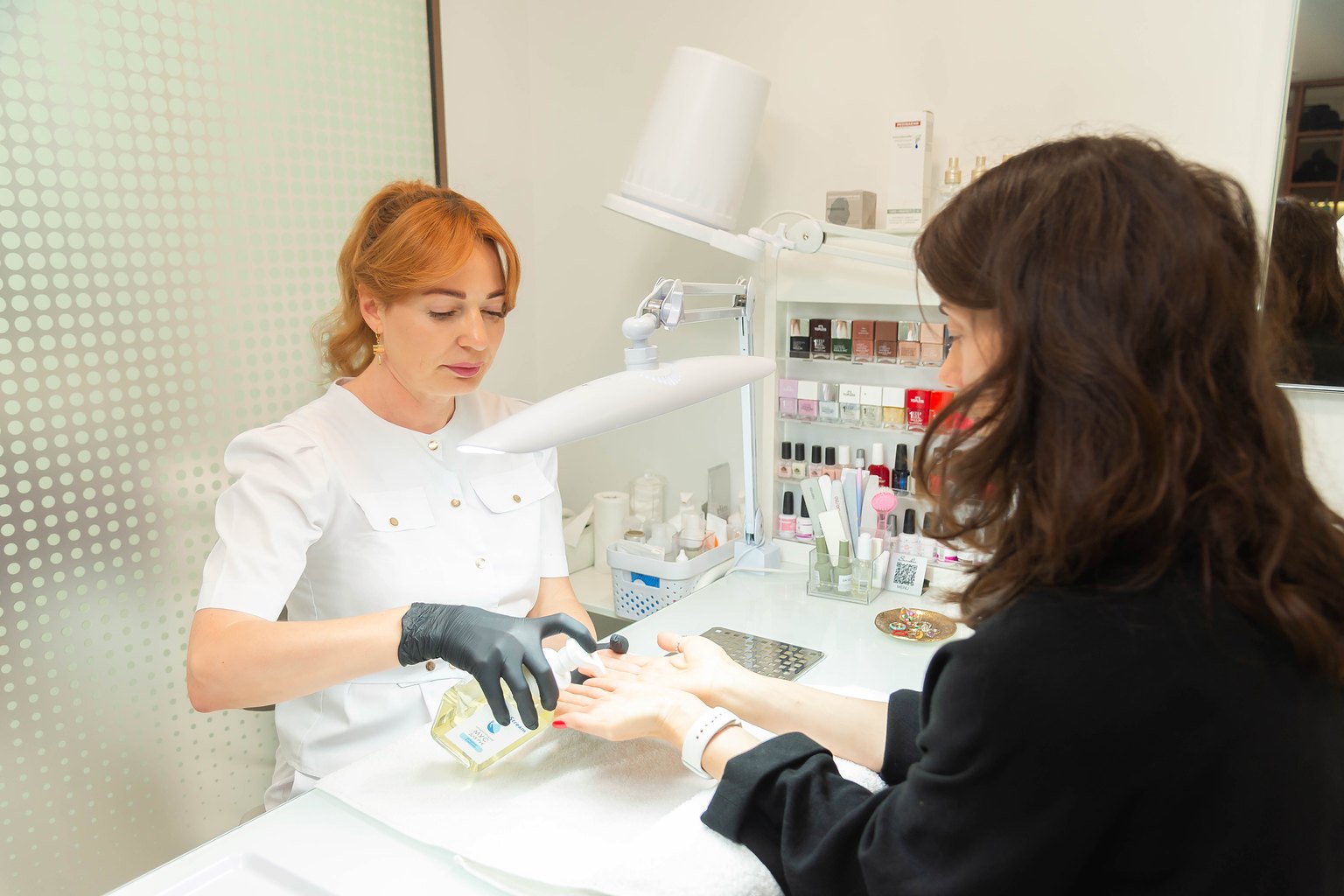
Gel nail correction is the restoration of the shape, balance, and coverage of an already extended nail without completely removing it. The fundamental difference from nail extension is that the technician works with the existing structure: removing the overgrown part, leveling the stress zone, and renewing the gel structure.
It sounds simple. But technically, this is a more complex procedure than the initial extension. Why? Because it is necessary to accurately determine where the living nail ends and where the gel overlay begins, where micro-cavities and adhesion disruptions have appeared. Poorly performed correction can lead to lifting within a week.
There are two types:
Correction without changing the coverage — when the shape and color are preserved. The technician files and adds only to the growth area.
Correction with design change — when the client wants a new shape or color. The top layer is removed completely or partially, and then a new one is applied.
In our practice, I often explain to clients the analogy of wheel balancing: you can ignore it, but the structure will begin to break down. The gel overlay is a physical extension of the nail with its own center of gravity. As the nail grows, the center of gravity shifts towards the free edge. The load concentrates in the stress zone — where the gel matrix meets the natural plate. Micro-cracks, lifting, breakage — a typical scenario without timely correction.
What a standard correction at Sandler Wellness Center includes:
- Removal and treatment of the growth area with a device
- Removal of the overgrown part (filing the free edge)
- Leveling the surface and stress zone
- Application of new gel in the matrix area
- Shaping and final polishing
- Design or coverage change (upon separate request, additional service)
How Often Is Nail Correction Needed: Protocols and Real Practice
The standard protocol in nail services is correction every 3–4 weeks. However, this is an average value, and I always caution: you should focus on your own nail growth rate, not on your friend's calendar.
There are several key indicators:
External signs that correction is overdue:
- The overgrown part exceeds 4–5 mm (the "natural" nail plate is visible)
- There is a feeling of imbalance or discomfort when pressing
- The nail has started to "play" — slight lifting from the side rolls
- The gel has darkened or yellow spots have appeared under the coverage
Individual factors that accelerate growth:
Pregnancy, taking biotin (according to Mayo Clinic, 2023, daily doses over 5 mg accelerate nail growth by 15–20%), summer season (increased temperature stimulates microcirculation), hormonal changes.
For such clients, I recommend correction every 2–2.5 weeks. This is not marketing — it is basic mechanics.
Comparison of intervals depending on the type of nails:
| Client Type | Recommended Interval |
|---|---|
| Slow nail growth | 4 weeks |
| Average growth | 3 weeks |
| Fast growth, pregnancy | 2–2.5 weeks |
| Sports load on hands | 2.5–3 weeks |
Results and Scientific Evidence: Why Regular Correction Protects the Nail
The main value of timely correction is not beauty, but the preservation of the nail plate. This must be understood clearly.
A study in the British Journal of Dermatology (2021, n=562) found that among clients who exceeded the recommended correction interval by more than 2 weeks, the risk of onycholysis (lifting of the plate from the bed) increased by 2.3 times compared to those who adhered to a 3–4-week cycle.
What happens to the nail without correction:
1–2 weeks overdue. There are no critical changes yet, but the stress zone begins to experience uneven loading.
3–4 weeks overdue. The gel in the matrix area dries out and partially loses adhesion. Micro-cavities appear — an ideal environment for fungal or bacterial flora.
5+ weeks. Real risk of nail detachment from mechanical impact. The plate under the gel is often already thinned due to mechanical stress.
In our practice at Sandler Wellness Center, I observe that clients who adhere to a regular 3–4-week cycle have noticeably stronger nail plates after 6–12 months than those who come in sporadically. Properly applied gel on a healthy plate is support, not damage.
What to realistically expect after a course of regular corrections (3–6 months):
- Leveling of the nail plate thickness
- Reduced brittleness of the natural nail
- Preservation of shape without significant restructuring
- Time savings on procedures (the technician does not have to start "from scratch")
Contraindications and Safety: Who Should Consult Before Correction
Gel nail correction is a safe procedure. However, there are conditions under which it should either be postponed or replaced with an alternative.
Relative restrictions (consultation required):
- Nail psoriasis — gel may worsen aeration of the plate
- Type 2 diabetes — reduced regeneration, higher risk of infection
- Chemotherapy or immunosuppressive therapy — nail plate is fragile, high skin sensitivity
- Healthy person without chronic dermatological conditions — correction is allowed
- Pregnancy — allowed, but avoid odors in poorly ventilated spaces
Allergy to gel is rare but real. If itching, swelling, or redness of the rolls occurred after the previous procedure — inform the technician before starting the correction. At Sandler Wellness Center, we can always perform an alternative coverage or replace the gel formula.
An important point regarding hygiene: tools between clients must undergo complete sterilization. Ask about this directly — it is your right.
Price of Nail Correction at Sandler Wellness Center, Kyiv
At Sandler Wellness Center located at 23 Kniaziv Ostrozky St, Kyiv, gel nail correction is available at a transparent price list with no hidden fees.
Main nail service positions:
| Service | Price |
|---|---|
| Gel nail correction | 3,200 UAH |
| Gel nail correction French | 3,500 UAH |
| Gel extension Catherine (initial) | 4,200 UAH |
| French gel extension (initial) | 4,500 UAH |
| Nail strengthening (gel) | 2,300 UAH |
| Gel removal | 1,000 UAH |
| Nail coverage with gel polish | 850 UAH |
| Gel polish removal | 500 UAH |
| Spa care for hands | 1,200 UAH |
Correction includes apparatus treatment of the growth area, leveling, application of new gel, and final polishing. Design and gel polish coverage are separate, according to the price list.
You can schedule an appointment through the website sandler.com.ua or by phone. The administrators of Sandler Wellness Center will select a time and consult you on preparation.
Prices may change — please confirm the current cost with the administrator or on sandler.com.ua.
Frequently Asked Questions About Nail Correction
Q: How many weeks after extension is nail correction needed?
A: The standard interval is 3–4 weeks after extension or the previous correction. If nails grow quickly (for example, during pregnancy or when taking biotin), the interval shortens to 2–2.5 weeks. The guideline is that if the natural nail has grown more than 4 mm from the cuticle, it’s time to see the technician. Ignoring this timeframe for 5+ weeks increases the risk of plate lifting by 2.3 times.
Q: Can correction be done without removing the old gel?
A: Yes, this is how classic correction is performed. The old gel is not completely removed — the technician only removes the overgrown part and levels the stress zone, then adds gel in the matrix area. Complete removal and re-extension is only advisable if the gel has lifted, there are signs of infection, or the client wants to completely change the shape of the nails.
Q: How long does nail correction take?
A: On average, 60–90 minutes. The exact time depends on the condition of the nails, the chosen design, and the growth rate. Correction with a change of coverage takes longer — up to 2 hours. The first correction after extension is usually quicker than subsequent ones if the client adheres to the recommended intervals.
Q: Is nail correction painful?
A: No, the procedure is painless with the correct technique. Mild discomfort may occur during apparatus treatment of the cuticle area — but not pain. If there is a sharp burning sensation or pressure during polymerization (light curing), this may signal too thick a layer of gel or hypersensitivity. In this case, the technician adjusts the application technique.
Q: Can correction be done during pregnancy?
A: Yes, gel nail correction during pregnancy is not prohibited. The main condition is good ventilation of the room, as gel odors can cause nausea, especially in the first trimester. At Sandler Wellness Center, the rooms are equipped with exhaust ventilation. For other restrictions — consult your gynecologist if you have any doubts.
Q: What will happen if I don't do correction at all and just remove the gel?
A: If you decide to stop using gel — it must be removed properly, either by softening with acetone or using an apparatus method, not by pulling it off. After removal, your natural nails will remain thinner for some time than before extension. Supporting them can be done with gel strengthening (2,300 UAH in the Sandler Wellness Center price list) or a course of therapeutic polish.
Conclusion
Nail correction is not a luxury and not something you can "wait another week" for. It is a technical necessity dictated by the physiology of nail growth and the mechanics of the gel structure. Timely 3–4-week cycles preserve the nail plate, prevent infections, and ultimately cost less than treating the consequences of neglected extensions.
At Sandler Wellness Center located at 23 Kniaziv Ostrozky St, Kyiv, each correction is performed according to a clear protocol — with apparatus treatment, stress zone monitoring, and hygienic sterilization of tools. We do not just "refresh" nails, but track the condition of the nail plate dynamically.
Detailed information about nail service offerings and the current schedule of technicians can be found at sandler.com.ua. You can schedule an appointment online or by calling the center's administrators.