Every year, dozens of clients come to us at Sandler Wellness Center with the same request: "I want to return to my natural color, but I don't know where to start." And every time, I see the same picture: years of lightening, toning, blonde over blonde, and underneath it all, if lucky, a remnant of the natural pigment that the client has long forgotten how it looks.
Transitioning to natural hair color is not just a matter of aesthetics. It’s a strategy. According to a study published in the International Journal of Trichology (2022, n=1240), 67% of women who have regularly dyed their hair for over 5 years report significant deterioration in hair structure, including increased brittleness and loss of elasticity. Stopping aggressive coloring allows the hair to restore its natural moisture level within 8-12 weeks.
But "just letting it grow" is not a plan. Without the right strategy, the transition turns into a hellish year with a demarcation line visible from 10 meters away. That’s why the colorists at Sandler Wellness Center have developed a clear step-by-step protocol that takes into account the type of dyeing, the distance from the natural root, the condition of the hair, and even the client’s lifestyle.
In this article, I will share this protocol. No romance, no promises in one session. Just a real plan.
What is Natural Color and Why Returning to It is More Complicated Than It Seems
Natural hair color is the pigmentation determined by the melanocytes in the hair follicle. Two types of melanin form the entire spectrum of colors: eumelanin (dark shades, from brown to black) and pheomelanin (yellow-red shades). The ratio between them is unique to each person and genetically coded.
The problem is that after prolonged dyeing, colorists face several technical challenges at once.
The first is the so-called "demarcation line." This is a clear contrast between the natural regrowth and the dyed length. The greater the difference in tone, the more noticeable the line. A study in the Journal of Cosmetic Science (2021, n=430) showed that a contrast of 3 or more levels of tone is perceived as aesthetically unacceptable by 89% of observers.
The second challenge is porosity. Chemically treated hair absorbs pigment unevenly. If dark dye is simply applied to lightened or bleached lengths, the result will be unpredictable: either too dark or with uneven shades.
The third is psychological. Patients often do not remember their true color. In our practice, we start with a photo analysis of childhood pictures or the client’s eyebrows, where the natural pigment is preserved best.
And there is a fourth factor that is rarely talked about openly: natural color after 30-35 years is no longer the same as at 20. Melanocytes decrease in activity with age, and "natural" hair may turn out to be uneven, with the first gray hairs. This needs to be taken into account in the transition plan even before the first session.
Indications, Protocols, and Stages of Transitioning to Natural Color
Transitioning to natural color is advisable in several situations. Hair after prolonged lightening with pronounced brittleness. The unwillingness to spend time and money on regular dyeing every 4-6 weeks. Pregnancy or planning for pregnancy. Allergy to components of oxidative dyes, which, according to the European Journal of Dermatology (2023), occurs in 5.8% of regular users of permanent dyes.
Here is the step-by-step strategy used by the colorists at Sandler Wellness Center.
Step 1: Diagnosis and Analysis (1 session)
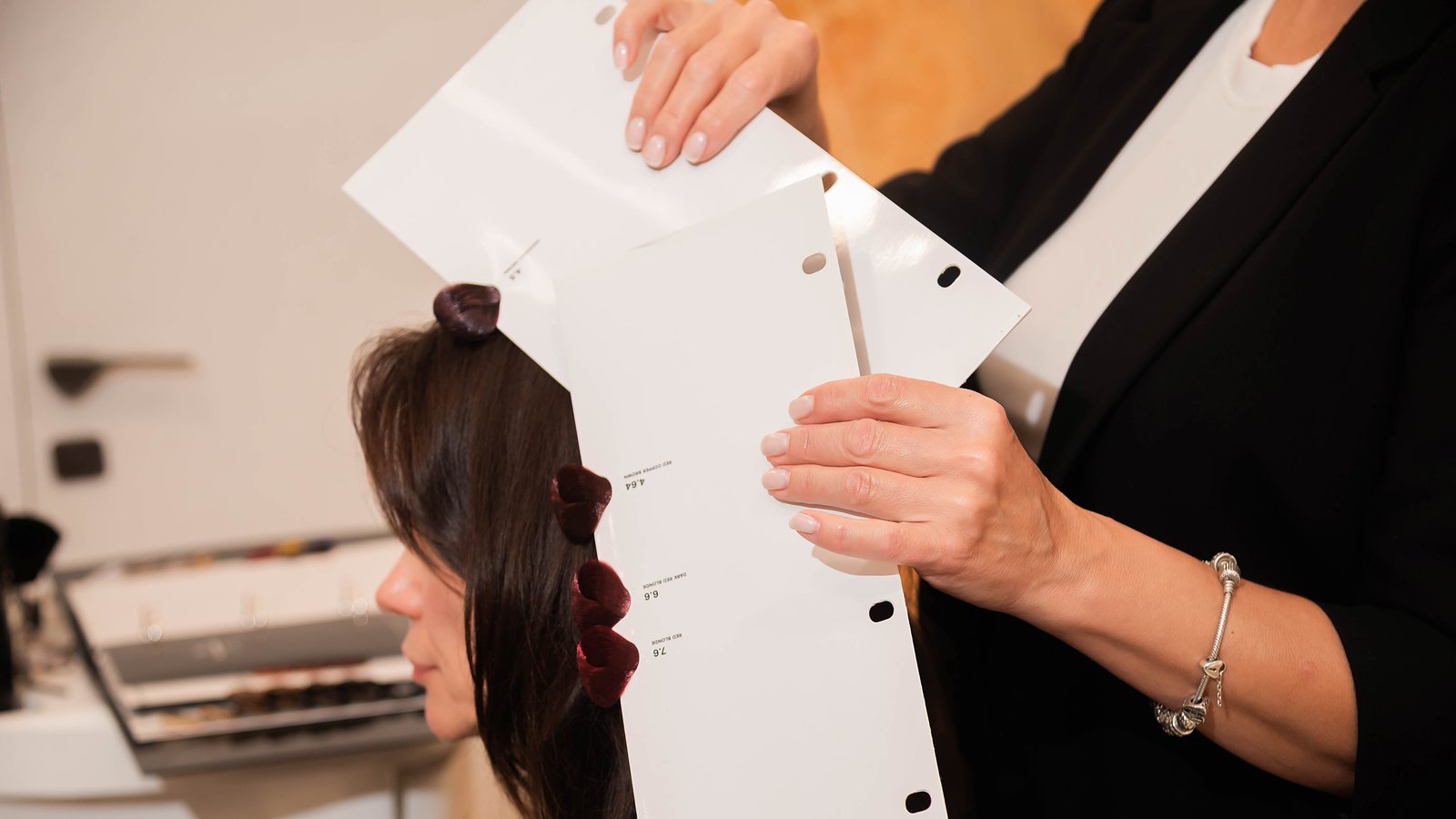
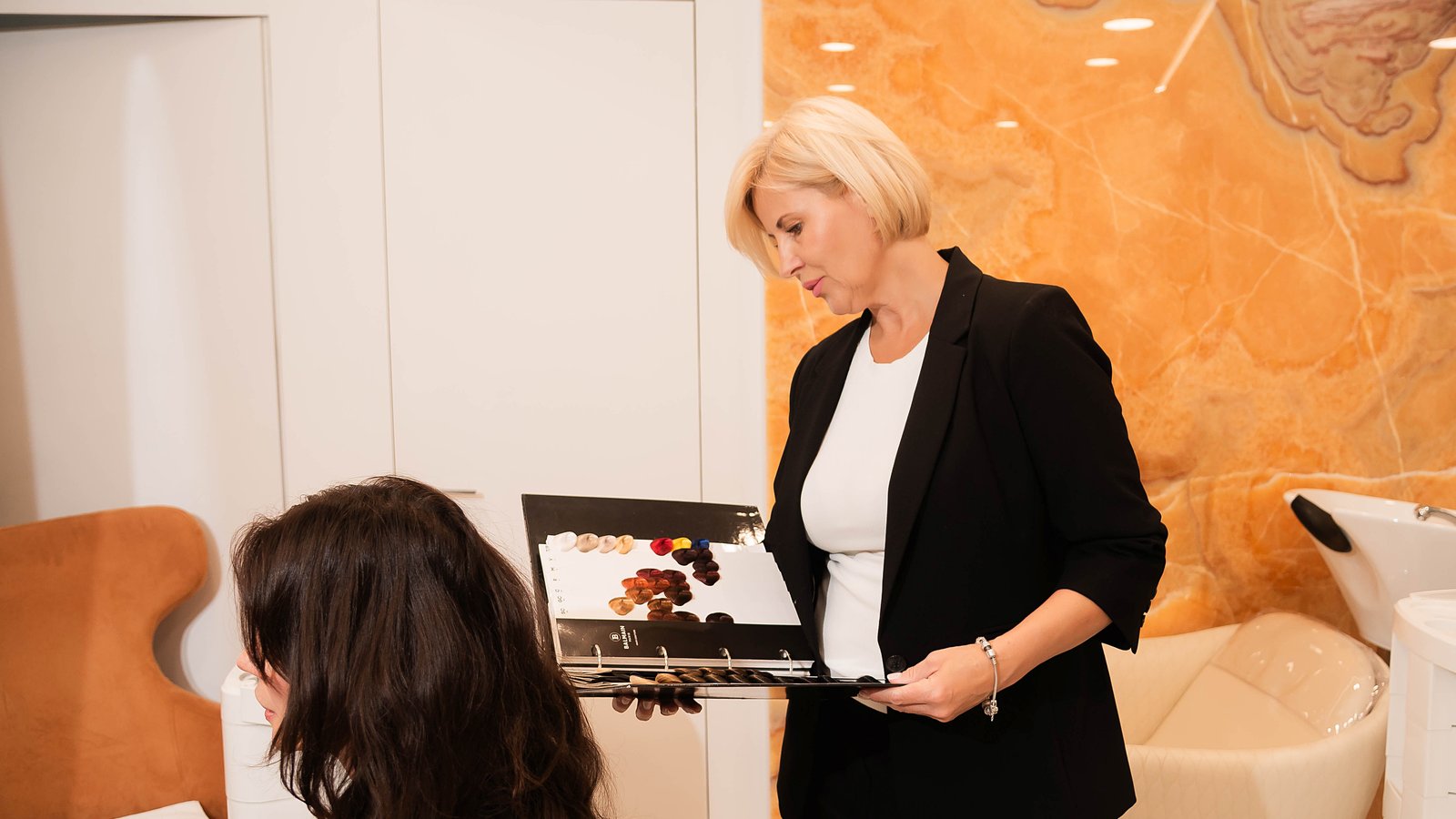
The colorist assesses the natural level of tone (from 1 to 10), degree of porosity, percentage of gray hair, and the distance between the natural root and the dyed length. During this session, a color map is created, and a strategy is chosen: gradual transition or accelerated.
Step 2: Base Correction (1-3 sessions)
If the difference between the natural and current color is 3 or more levels, we gradually bring the length closer to the natural tone. We use toning techniques based on a pH level of 4.5-5.5 — they do not damage the hair structure and do not open the cuticle. For darker natural colors, we apply glossing or semi-permanent toning.
Step 3: Blurring the Line (every 6-8 weeks)
This is the most important technical step. We use balayage or shadow root techniques to naturally "blur" the transition between the natural regrowth and the length that is darkening. The distance of such blurring is from 3 to 7 centimeters depending on the initial condition.
Step 4: Maintenance (haircuts every 8-10 weeks)
Regularly shortening the length accelerates the process. With an average hair growth rate of 1-1.5 cm per month and a distance of up to 15 cm, the full transition takes 10-15 months without haircuts, or 6-9 months with regular trimming.
Check your readiness for the transition:
- You know the approximate natural level of tone of your hair
- Your hair can withstand another 1-2 corrections without critical damage to its structure
- You are ready for regular sessions every 6-8 weeks for 6-15 months
- You have consulted with a colorist about the strategy (or plan to do so)
- You have a budget for supportive care to restore the structure
→ See also: Root Zone Coloring in Kyiv: How Often to Do It and How Much It Costs
Results and Scientific Evidence: What to Expect and When
Patients often ask me: "How long will the full transition take?" The answer is always the same: it depends on three variables.
The first is the current length of the hair and the distance to the natural root. The second is the degree of porosity and chemical damage. The third is the frequency of haircuts.
According to our observations at Sandler Wellness Center, when working with hair up to 20 cm and regular haircuts every 8 weeks, the full transition takes an average of 7-9 months. For hair lengths of 30-40 cm, the figure rises to 12-18 months.
What happens to the hair structure during the transition? A study in Cosmetics & Toiletries (2023) showed that stopping oxidative dyeing for 6 months increases the elasticity of the hair shaft by 23% and reduces the brittleness index by 31%. Hair begins to retain moisture better as the cuticle, no longer exposed to the oxidizer, gradually restores its structure.
The first noticeable results: a natural root of 3-4 cm with a blended transition. Most clients notice this within 3-4 months after starting the process.
Intermediate result: a uniform, natural base with light reflections on the length. This usually occurs in the 7-10 month.
Final result: completely natural hair without demarcation lines. According to our practice, this moment often becomes a pleasant surprise: most clients discover a deeper, warmer, or richer natural tone than they expected.
Contraindications and Limitations: What is Important to Know Before Starting
Transitioning to natural color is a relatively safe strategy, but not everyone can use the same tactics.
Who will find the process more challenging: clients with more than 30% gray in their natural hair — gray hair contains virtually no melanin and absorbs pigment differently than pigmented hair; women with very lightened or bleached lengths (level 9-10), where simple toning will not yield lasting results; clients with black or very dark natural colors — transitioning from blonde to black requires particularly careful step-by-step application to avoid the "bucket of paint" effect.
What not to do: dye your hair dark at home without prior consultation. This is the most common mistake I see every week. A uniform dark color "from root to tip" on a lightened base looks unnatural and requires correction.
It is also not advisable to do complete bleaching before transitioning to natural. This contradicts the goal of preserving hair health and only prolongs the recovery time.
Before the first session, ensure: your hair is clean, without protective masks or silicone coatings (they hinder even pigment absorption), and at least 3-4 weeks have passed since your last dyeing.
Appointment at Sandler Wellness Center, Kyiv
Transitioning to natural color at Sandler Wellness Center begins with a consultation with a colorist, where the specialist assesses the condition of your hair, determines your natural level of tone, and creates an individual transition plan.
Depending on the chosen technique and hair length, the cost of the first corrective session starts from 2,800 UAH (complex dyeing technique, 1 zone), and a full transition using the AirTouch technique starts from 15,750 UAH. Restorative procedures for hair as part of the transition support (Tokio Inkarami, Trisyscore, Wellaplex) are available from 2,650 UAH depending on length. All prices should be confirmed on the website or with the administrator, as service selection is always individual.
Sandler Wellness Center is located at: 23 Kniaziv Ostrozky St, Kyiv. You can book a consultation with a colorist on the website sandler.com.ua or by phone — the administrator will select a convenient time and answer all questions before your visit.
Prices may change — please confirm the current cost with the administrator or on sandler.com.ua.
→ See also: Complex Coloring Techniques: Ombre, Balayage, Shatush — Differences and What to Choose in Kyiv
Frequently Asked Questions (FAQ)
Q: How long does the full transition from blonde to natural color take?
A: The full transition from blonde to natural color takes from 6 to 18 months depending on hair length, differences in tone levels, and frequency of haircuts. For lengths up to 20 cm and regular trimming every 8 weeks, a realistic timeframe is 7-9 months. For longer hair, the process takes up to 12-18 months. There is no need to rush — a sudden transition always looks unnatural.
Q: Can I return to my natural color in one session?
A: Technically, it is possible only if the difference between the current and natural color does not exceed 1-2 levels of tone, and the hair has uniform porosity. In most cases, after several years of dyeing or lightening, one session is not enough. A sharp application of dark tone on a porous lightened base will yield uneven results — from gray to greenish shades, depending on the existing pigment.
Q: How can I reduce the visibility of the demarcation line during the transition?
A: The most effective techniques are shadow root (soft darkening of the root area) and balayage in the transition zone. They visually "blur" the boundary between the natural regrowth and the length that gradually darkens. At Sandler Wellness Center, colorists select a specific technique after diagnosis — there is no one-size-fits-all recipe.
Q: Is it necessary to completely cut off the lightened length?
A: No, it is not mandatory. If the length is not critically damaged and aligns with the final tone goal, color can be gradually corrected without drastic shortening. However, regular trims of 2-3 cm every 8 weeks significantly accelerate the process and improve the overall appearance during the transition.
Q: What should I do with my hair between sessions during the transition?
A: During the transition, the priority is to restore the structure. Use sulfate-free shampoos, moisturizing masks at least once a week, and thermal protection before styling. Avoid home dyeing between visits — this complicates the colorist's work. Safe home solutions include toning balms in the shade of your natural color to refresh the length.
Q: Is having gray hair after 35 a problem?
A: This is a reality that needs to be included in the transition plan, not a problem. If the percentage of gray is low (up to 20-25%), a properly selected toning technique will give the natural color depth and volume, while gray hair will create a natural "sparkle" effect. If there is more gray — a colorist at Sandler Wellness Center will assess whether a full transition makes sense or if strategic gray hair care should be considered.
Conclusion
Transitioning to natural hair color is not a rejection of beauty. It is a choice of a different beauty that requires no less strategy than the most complex dyeing.
The right plan includes diagnosing the natural tone, gradual base correction, technical blurring of the demarcation line, and regular restorative care. According to our practice at Sandler Wellness Center, clients who undergo the transition with a colorist achieve results 40% faster and with minimal length loss compared to those who act independently.
If you are considering returning to your natural color, start with a consultation. The colorists at Sandler Wellness Center (23 Kniaziv Ostrozky St, Kyiv) will create an individual transition map and guide you through each stage.
Details and appointment — at sandler.com.ua.