Every year, over 3,000 new cases of melanoma are registered in Ukraine — and most of them are detected at late stages. Not because people haven't noticed changes. But because they didn't know what to look for. The ABCDE rule addresses this issue: it is a standardized clinical self-diagnosis algorithm recommended by dermatology oncologists worldwide for monthly skin examinations.
I see this every week: a person comes in with a mole that has been there for 10 years and says — "it has always looked like this." But three months ago, one edge became unclear, and a brown spot appeared nearby. This is the two-minute check that could have brought the person to us much earlier.
Melanoma detected at stage I is treatable in 98% of cases (according to the American Cancer Society, 2024). At stage IV, this figure drops to 22–25%. The difference is colossal. That’s why at Sandler Wellness Center, we don't just remove formations — we teach patients to systematically monitor their skin. Regular self-examination plus an annual consultation with a dermatology oncologist is real prevention.
This article is written for those who want to understand the algorithm, not just memorize an abbreviation. We will break down each criterion from a clinical perspective, outline real norms and deviations, and explain when self-examination is no longer sufficient.
What is the ABCDE Rule and Where Did It Come From
ABCDE is a diagnostic algorithm developed by dermatologists from the American Academy of Dermatology (AAD) in 1985 and standardized by the WHO as a primary screening tool for melanoma. The abbreviation stands for: Asymmetry, Border, Colour, Diameter, Evolution.
Each criterion describes a specific morphological feature that correlates with the malignancy of nevi. It is important to understand: no criterion alone is a diagnosis. It is a trigger for consulting a specialist.
A — Asymmetry. Draw an imaginary line through the center of the mole. Both halves should be mirror images. If one half is larger, more raised, or of a different shape — that is asymmetry. Benign melanocytic nevi are generally symmetrical.
B — Border. The outline should be clear, even, without "blurriness" or pseudopodia. Uneven, jagged, or blurred edges are a sign that cells are beginning to migrate beyond the formation. In clinical practice, this is one of the most sensitive criteria: a study in the Journal of the American Academy of Dermatology (2022, n=1,240) showed that uneven borders increase the sensitivity of melanoma diagnosis to 84%.
C — Colour. A benign mole is uniform in color — from light beige to dark brown. The appearance of a second shade, black specks, gray or red areas — is a warning sign. Depigmented (white) areas inside the nevus may indicate regression, which also requires evaluation.
D — Diameter. The classic threshold is 6 mm (the size of a pencil eraser). But this is not an absolute rule. Small melanomas occur more frequently than patients think. Therefore, the more important criterion is not the absolute size, but the growth dynamics.
E — Evolution. The most important criterion. Any change over 4–8 weeks — in shape, color, relief, symptoms (itching, bleeding, peeling) — requires immediate consultation. A study in Cancer Epidemiology, Biomarkers & Prevention (2023, n=2,180) showed that the evolution of a nevus is the most sensitive predictor of melanoma with a sensitivity of 97%.
How to Properly Conduct a Self-Examination: Step-by-Step Protocol
Self-examination of the skin takes exactly 2 minutes — if done systematically. Patients often ask: "How can I miss something obvious?" You can. Because you examine your skin daily and stop noticing changes.
I recommend conducting the examination once a month, at the same time, with the same lighting.
What you need: bright daylight or fluorescent lighting, two mirrors (a large one and a handheld one), a hairdryer for examining the scalp. Take photos of all moles that concern you — this is your "baseline photo" for comparison over time.
Self-examination checklist according to the ABCDE rule:
- Examine the face, neck, ears (including the inner surface of the ear)
- Scalp — comb with a hairdryer, section by section
- Front surface of the torso, armpits, chest
- Abdomen, navel, groin area
- Back and buttocks (requires a handheld mirror or assistance)
- Entire arms, including nail beds and between fingers
- Legs and feet — especially the soles and between toes
The soles of the feet and nail beds are areas that patients most often miss. Yet this is where acral lentiginous melanoma often occurs, which has a worse prognosis due to late detection.
When to Seek Immediate Attention. Even without fully meeting the ABCDE criteria, there are symptoms for which you should not wait for a scheduled examination: bleeding of the mole, formation of a crust or ulcer, itching or burning that does not go away. Any new formation that appears after age 40 and grows rapidly is also a reason for an urgent consultation.
→ See also: Early Stage Melanoma: 5 Signs Only a Dermatoscope Can See
Scientific Evidence and Real Effectiveness of ABCDE
The ABCDE rule is not just a mnemonic scheme. It is backed by substantial evidence.
A systematic review by Cochrane (2021, 32 studies, n=14,000+) showed that the use of ABCDE criteria by patients increases the frequency of early medical consultations by 34% compared to a control group without training. The sensitivity of the algorithm when applied correctly is 57–90%, and specificity is 59–90% depending on the population.
Specifically regarding criterion E. In our practice at Sandler Wellness Center, it is "evolution" that most often brings patients to us in time. A person has had a mole for years and did not pay attention — and then noticed that it has become slightly darker or raised above the skin. This is the correct reaction.
It is important to understand the limitations of the method. A study in the British Journal of Dermatology (2022, n=890) showed that patients without medical education correctly identified all 5 signs only in 41% of cases. The criteria for color and borders were assessed the least accurately. Hence the conclusion: ABCDE is an excellent tool for raising alarm (i.e., motivation to consult a doctor), but not for self-diagnosis.
What can you realistically expect after implementing regular self-examination? According to the WHO (2024), patients who perform monthly skin self-examinations consult a dermatologist on average 2.3 months after new signs appear compared to 11.4 months for those who do not perform self-examinations. A difference of 9 months is often a difference in disease stage.
Contraindications and Limitations of Self-Examination: Who is at Risk
Self-examination according to ABCDE has specific limitations, and it is important to discuss them openly.
Who needs more frequent professional monitoring. Patients with more than 50 melanocytic nevi carry a higher baseline risk of malignancy — even if each individual mole looks normal. The same applies to individuals with dysplastic nevi (atypical histologically), people with fair skin (Fitzpatrick phototype I-II), red hair, a history of recurrent sunburns, and a family history of melanoma.
Anatomical areas that cannot be adequately examined independently. Skin on the back, the back of the neck, the scalp, the anal area, mucous membranes — require external assistance or instrumental examination. The soles of the feet and nail beds are also high-risk areas that patients systematically miss.
Congenital (birth) nevi larger than 20 mm have a risk of malignancy of 0.7–2.9% over a lifetime (Pediatric Dermatology, 2021) and require regular dermatoscopic monitoring from childhood.
The general principle: ABCDE reduces the risk of "missing" melanoma, but does not eliminate the need for annual professional dermatoscopy. These two approaches complement, not replace, each other.
Consultation with a Dermatology Oncologist and Prices at Sandler Wellness Center, Kyiv
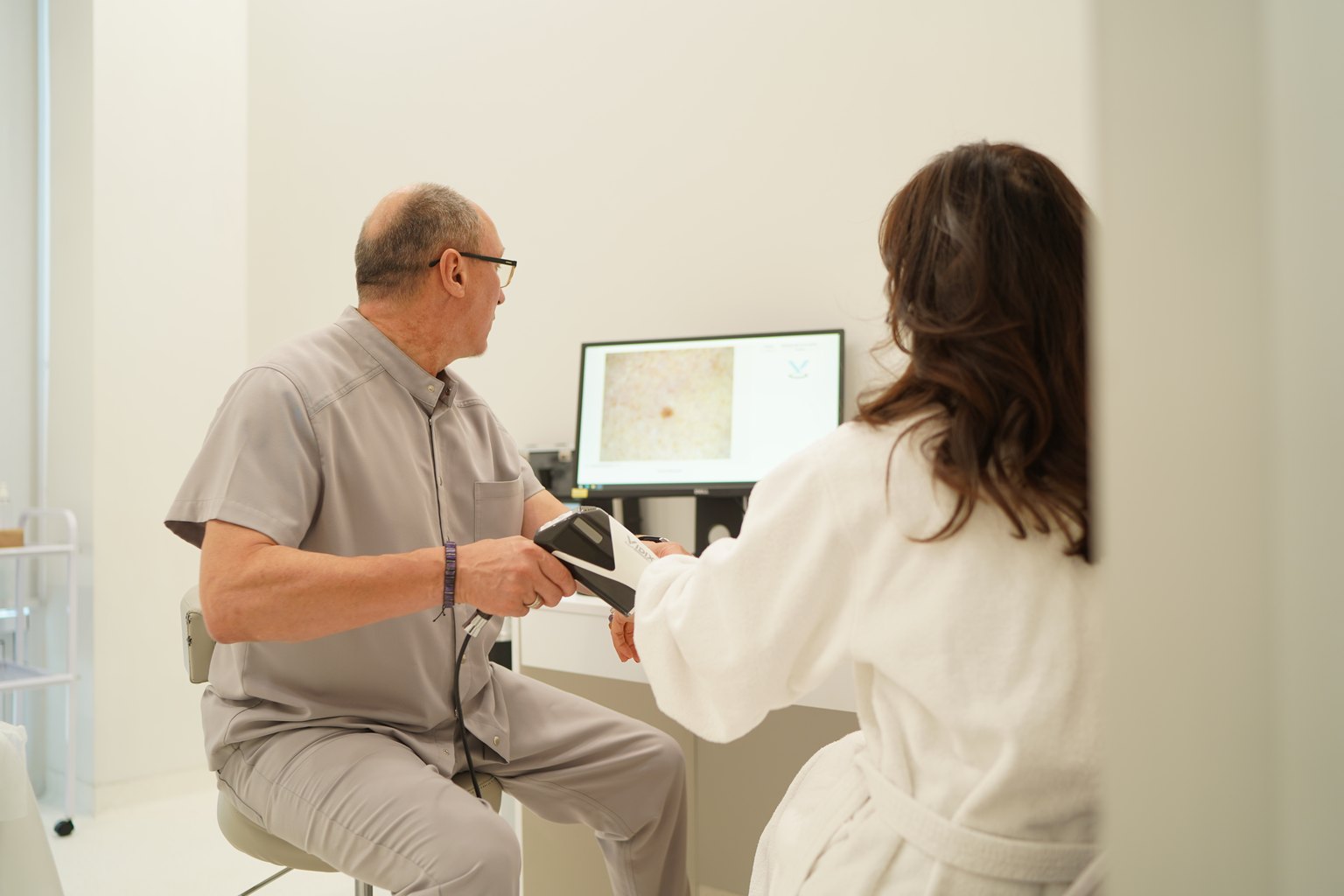
If self-examination reveals alarming signs or you simply want to have a routine check of all nevi — Sandler Wellness Center at 23 Kniaziv Ostrozky St, Kyiv offers a consultation with a dermatology oncologist with VIDIX dermatoscopy.
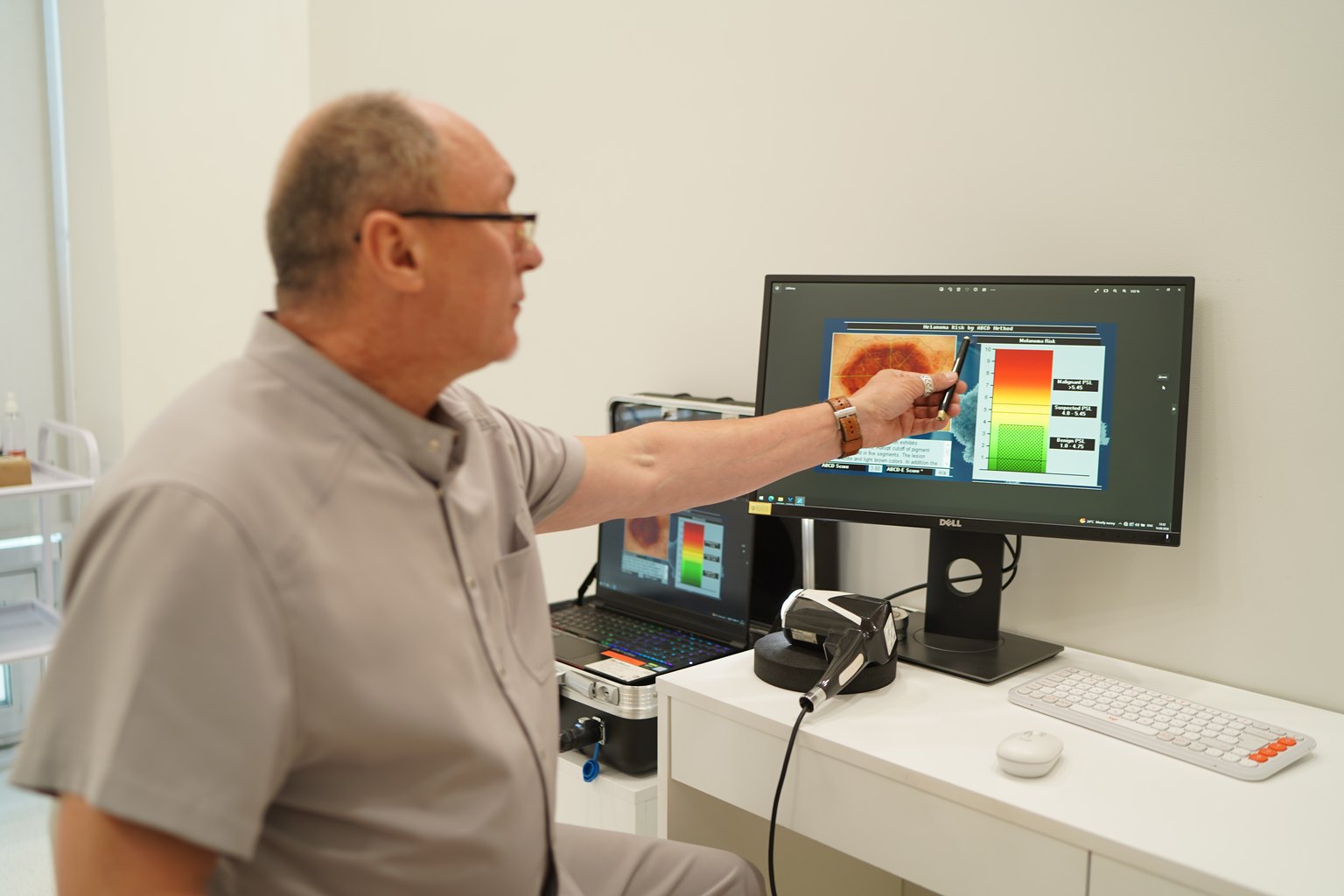
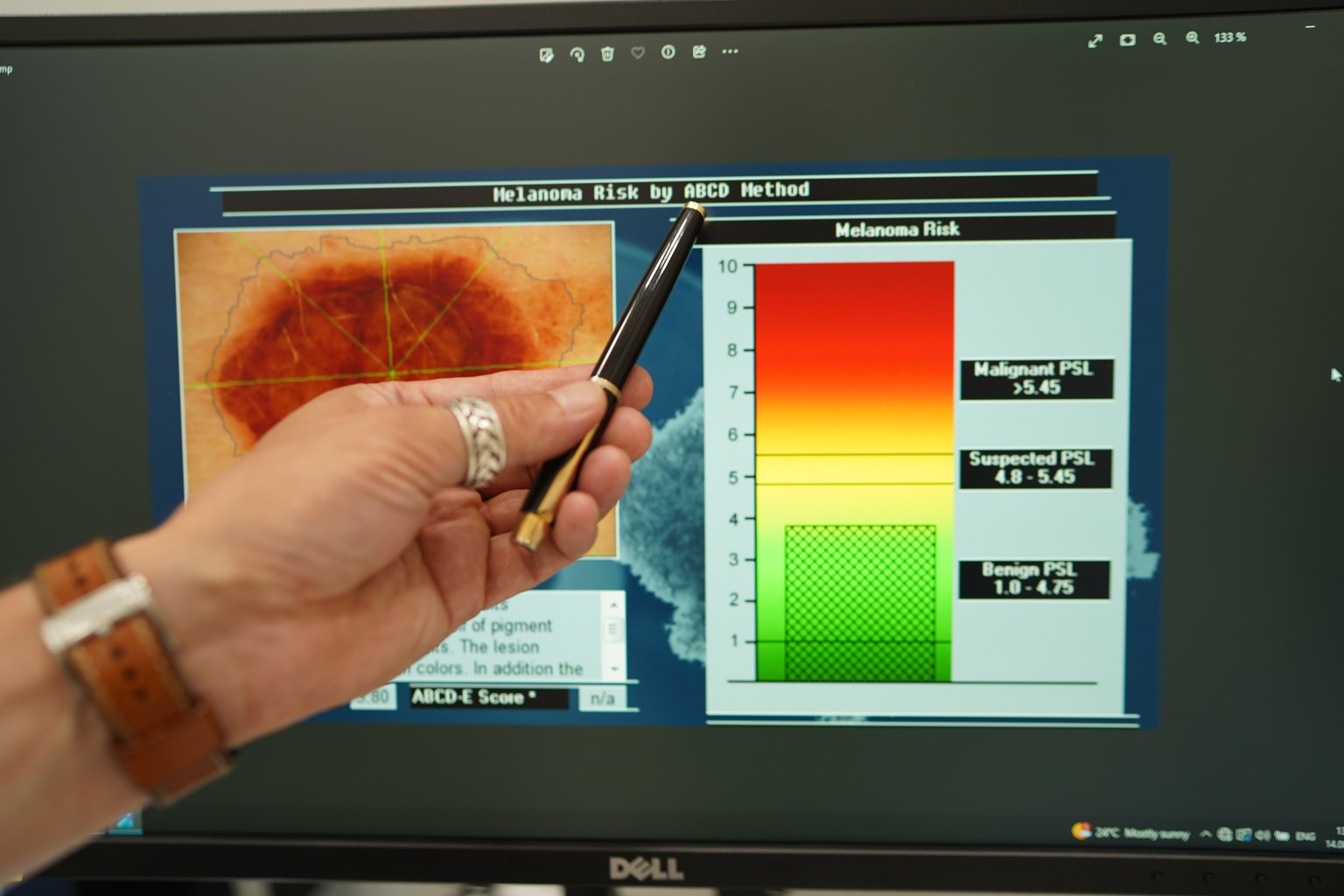
VIDIX is a digital video dermatoscope with 20x magnification and software analysis of pigment structures. It allows for the assessment of vascular patterns, pigment levels, and structural atypias that are invisible to the naked eye. According to the European Journal of Dermatology (2023), digital dermatoscopy increases the accuracy of melanoma diagnosis to 89% compared to 74% with clinical examination without magnification.
Service Prices:
| Service | Price |
|---|---|
| Consultation with an oncologist, PhD + VIDIX dermatoscopy | 3,500 UAH |
| Follow-up consultation with an oncologist, PhD + VIDIX dermatoscopy | 1,600 UAH |
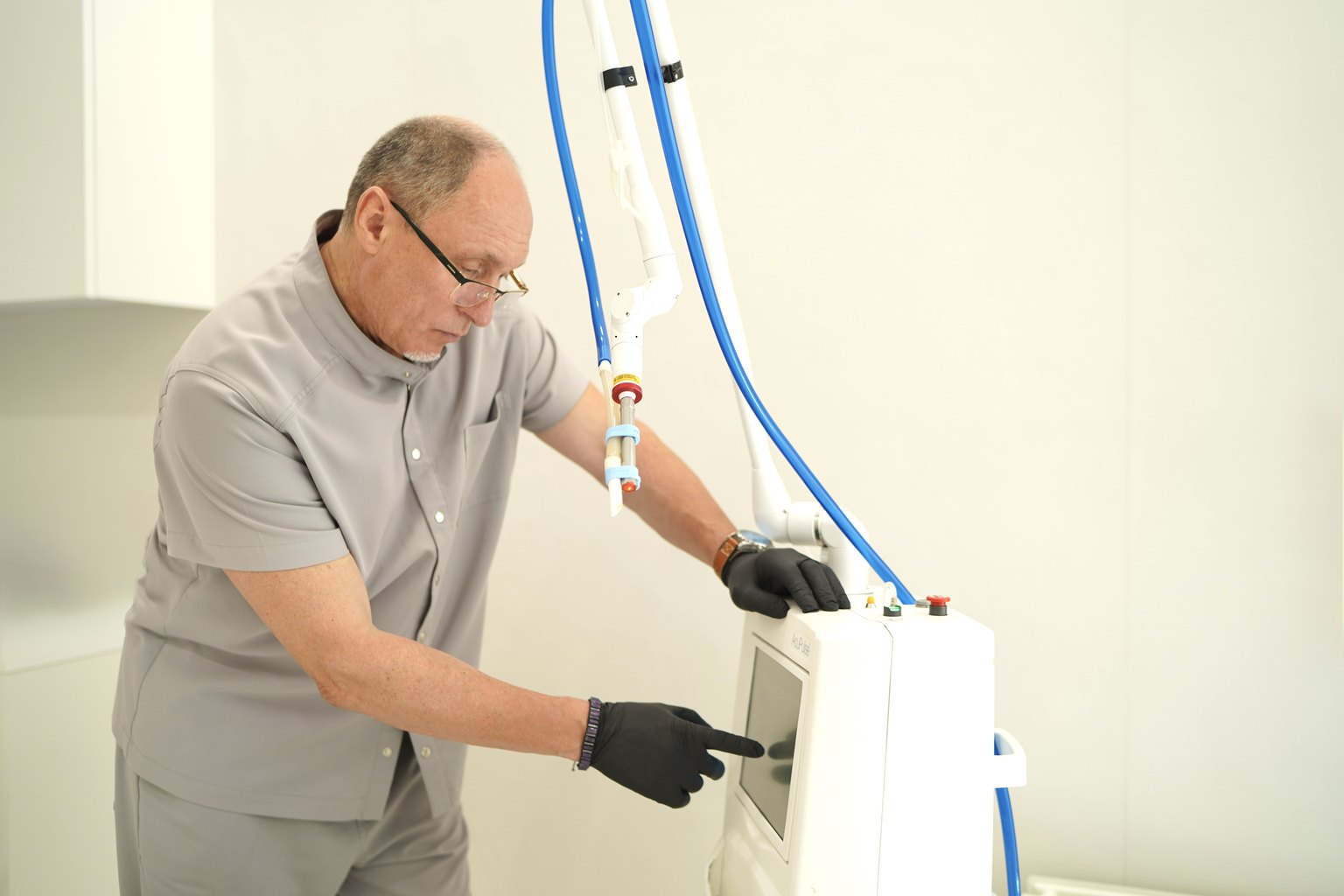
| Laser-radio wave removal of skin formations | from 1,000 to 30,400 UAH |
| Histological examination | 1,200 UAH |
What is included in the initial consultation: history taking, assessment of risk factors, dermatoscopy of all concerning formations, documentation describing each nevus, recommendations for further monitoring or removal.
You can book an appointment on the website sandler.com.ua or by calling the administrator. Sandler Wellness Center is open for patients who choose a preventive approach to skin health rather than a reactive one.
Prices may vary — please confirm the current cost with the administrator or on sandler.com.ua.
Frequently Asked Questions about Mole Checking According to the ABCDE Rule
Q: How often should I check my moles according to the ABCDE rule?
A: The optimal frequency for self-examination is once a month. A systematic monthly review allows you to notice changes in a timely manner that a person does not notice with daily contact with their skin. I recommend tying the examination to a specific day of the month — for example, the first day. Photographing all nevi larger than 3 mm significantly increases the accuracy of self-assessment over time.
Q: Which mole is dangerous — how to understand using ABCDE?
A: A mole is alarming if it meets at least one ABCDE criterion: asymmetrical shape, uneven or blurred borders, two or more shades of color, diameter greater than 6 mm, or any change in the last 4–8 weeks. The presence of two or more criteria significantly increases the likelihood of atypia and requires urgent consultation with a dermatology oncologist.
Q: Can a mole be melanoma if it is small and dark but has no other signs?
A: Yes. The so-called "nodular melanoma" may not meet the classic ABCDE criteria — it grows vertically, can be uniform in color, and relatively small. That’s why criterion E (evolution) is the most important: any new formation that appears after age 40 and increases over a few weeks is a reason for consultation, regardless of the other criteria.
Q: How much does mole dermatoscopy cost in Kyiv at Sandler Wellness Center?
A: A consultation with a dermatology oncologist, PhD, along with VIDIX dermatoscopy costs 3,500 UAH for the initial visit and 1,600 UAH for a follow-up. The cost includes an examination of all concerning formations, their documentation, and recommendations. You can book an appointment at sandler.com.ua or by calling the administrator of Sandler Wellness Center, 23 Kniaziv Ostrozky St, Kyiv.
Q: Should a mole be removed if it meets the ABCDE criteria?
A: Not necessarily right away. The presence of ABCDE signs is a signal for dermatoscopic evaluation, not an automatic indication for removal. The doctor will assess the structure of the formation under magnification, compare it with previous images (if available), and make a decision: dynamic observation, photographic monitoring, or removal with subsequent histology. Removal without histological examination in cases of suspected atypia is a mistake: histology provides the final answer about the nature of the cells.
Q: What does "evolution" of a mole mean and how to track it?
A: Evolution refers to any change in a nevus over a period of 4–8 weeks: increase in size, change in color or relief (raised above the skin or, conversely, depressed), appearance of symptoms (itching, burning, bleeding, peeling). The simplest way to track it: photograph the mole next to a ruler or coin, save the photo with the date, and compare monthly. This criterion in our practice at Sandler Wellness Center proves to be decisive in most confirmed cases of melanoma.
Conclusion
The ABCDE rule is not a panacea and not a substitute for a doctor. It is discipline. Two minutes once a month, a systematic approach, and readiness to consult a specialist in a timely manner — this is what saves lives. Melanoma detected at stage I is treatable in 98% of cases. A delay of 9-12 months can drastically change the prognosis.
If you have found at least one ABCDE sign or simply do not remember the last time you showed your skin to a doctor — this is a signal to act now. At Sandler Wellness Center at 23 Kniaziv Ostrozky St, Kyiv, an initial consultation with a dermatology oncologist with digital VIDIX dermatoscopy is conducted. We document every nevus and monitor you over time — so that changes do not go unnoticed.
Book your appointment at sandler.com.ua. Two minutes of self-examination plus annual dermatoscopy is all the prevention you need.